
A promotion goes live and a best-selling product runs out, while orders continue to pile up. The return comes back, but your count remains wrong until someone notices. Your boss asks for inventory numbers, but you can’t answer without merging the data from three dashboards.
None of this is the result of one big logistical failure in e-commerce. There are about ten small ones, taking place in unrelated places.
An increase in order volume may reveal these errors, but is not the cause. The real problem is a lack of connection and visibility. Your systems don’t talk to each other.
The good news? This can be resolved without completely rebuilding your system.
Can you trust your inventory numbers without logging into multiple systems?
When deciding what to replenish this week, do you rely on what sold in the last 24 hours or are you dealing with a report that is a few days behind?
Do you discover customer execution problems before your own tools identify them? How much time does your team spend manually copying data between systems?
Find the answers to these questions. If they make you feel uncomfortable, they’re pointing out real problems with visibility and connection. From there, you can get started connecting your website to the tools you use for inventory handling, fulfillment, and sales channels.
An all-in-one platform gives you one way to do things. It’s somewhat interconnected by default because so much lives in the same system. But the problem is that you have no say in that How it all works.
Composability is the opposite tradeoff. Instead of one system determining how everything works, you choose the tools that suit your company one by one. That gives you flexibility, but flexibility is not the same as visibility.
A stack of top-of-the-line tools that don’t talk to each other is just fragmentation with freedom of choice. Your ERP has one inventory count. Your shipping app has another one. Your 3PL has a third party.
The right path forward lets you choose the tools that fit the way your business runs, and then connect them together so everything appears on the same dashboard. Connections can be made through a built-in integration, a middleware platform that syncs it for you, or a direct API, but the goal is always the same: a single source of truth.
A key difference between an open source platform like WooCommerce and a proprietary platform is that WooCommerce doesn’t try to be that source of truth. It connects with it instead of having to work around it.
Connecting e-commerce logistics means deciding which system owns each piece of data, which event should trigger an update, and where that update should go.
With WooCommerce, these connections can be made through special extensions, middleware, or custom integrations using the REST API and webhooks. The REST API allows external systems to read and update store data, while webhooks can alert another system when something changes in WooCommerce.
In WooCommerce go to Settings → Advanced → REST APIgenerate a key and give it to the system that needs it. If your ERP or 3PL already has a WooCommerce connector, that’s as complicated as it gets.
Here’s what that looks like in four common parts of an e-commerce operation:
Order management and carriers
Let’s say a WooCommerce store uses ShipStation. Instead of someone copying new orders to a carrier portal, WooCommerce sends order information directly to ShipStation. Your team can then process orders, apply shipping rules, choose from affiliated carriers, and generate labels. Tracking information can flow back to the WooCommerce order and to the customer.
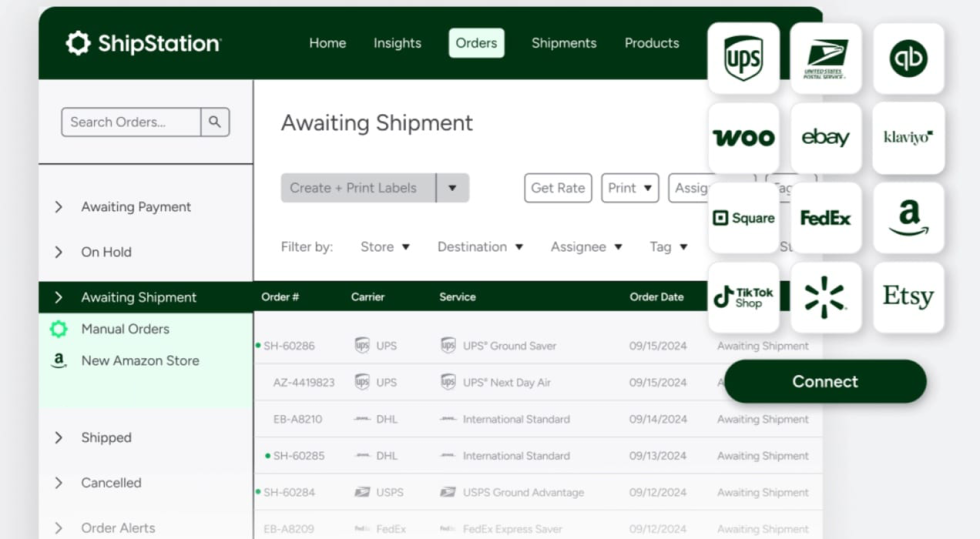
So the flow looks something like this:
WooCommerce order → ShipStation → carrier and shipping label → tracking back to WooCommerce
WooCommerce also has shipping extensions that handle parts of the process directly. For example, WooCommerce Shipping automatically generates a tracking number when you purchase a label and then stores it in the order.
Multi-channel sales and inventory
Multi-channel inventory becomes a little more complicated because you first have to decide which system is the source of the truth.
For example, Square for WooCommerce lets you choose which platform owns the product catalog. If WooCommerce is the source of the truth, changes to names, prices, descriptions, images, and categories can be synced from WooCommerce to Square. Inventory information also comes back from Square to account for sales at the point of sale.
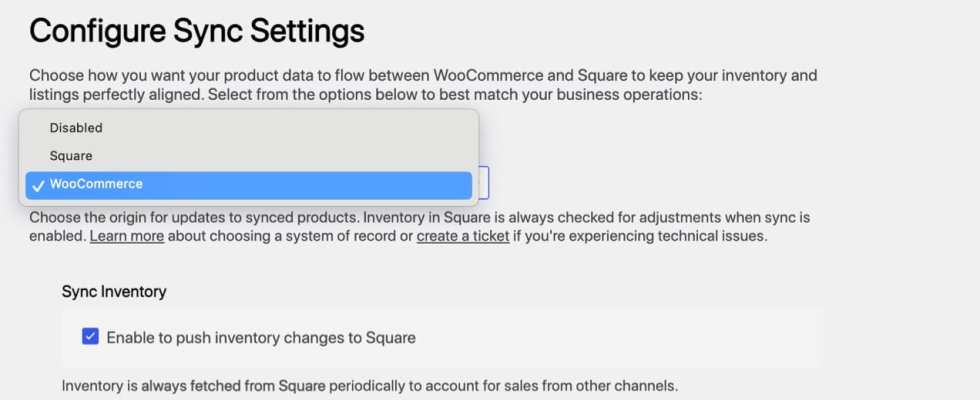
This creates two important flows:
WooCommerce product change → Square
In-store sales → Square inventory → WooCommerce inventory
Selling on the marketplace works the same way. If you also sell on eBay, Walmart or another marketplace, there is a multichannel integration between WooCommerce and those platforms to sync things like inventory, products and orders.
This is also where you need to look carefully at how often something syncs. Integrated does not automatically mean direct. If you sell a limited quantity of a high-speed product across channels, sync timing is critical.
Returns and inventory
Returns require a bit more logic, because a returned item is not always immediately available to resell. A good returns workflow consists of several steps:
Return requested → item received → item inspected → item restocked, quarantined, or marked as unsellable
The systems involved must agree on what these statuses mean and, more importantly, which system has permission to put that item back into the available inventory. It is important to ask yourself what statuses are shared, what triggers an inventory adjustment and which system ultimately controls the inventory count.
For example, your warehouse, WMS, 3PL or returns platform can handle the inspection. Once the item is approved for resale, that system can send the inventory change back to WooCommerce. For a custom setup, the REST API provides access to products, orders, and refunds, while webhooks can trigger activity in another system when something changes.
What to connect first
If you’re looking at all four of these and wondering where to start, start with taking inventory.
That’s not because it’s the easiest, but because it’s the factor on which everything else depends. Your fulfillment tools, your channel listings, and your 3PL are only as good as the inventory number they read from.
With a 3PL, inventory numbers are in a warehouse that you have no control over, making visibility more difficult and trust more important. If your 3PL provider doesn’t connect to your other systems, you’ve simply moved the disconnect somewhere else.
With the right integration, inventory counts, fulfillment status, and returns remain visible alongside the rest of your operations, with updates happening in real time instead of once a day. When an order ships, is delayed, returned, or stuck, that status should automatically appear in your store.
Typically, this type of integration already exists on your 3PL side. It’s a matter of connecting to it properly rather than relying on a manual solution.
You don’t have to solve every e-commerce logistics challenge at once. WooCommerce is built to let you close the gap that costs you visibility, without throwing away the tools that already work.
When the gap is filled, ShipStation compares live rates and prints labels for USPS, UPS, and DHL directly from your dashboard, so that step no longer lives in a separate carrier portal. For more carriers, multiple warehouses or multiple sales channels at the same time, Shippo and ShipStation expand the connection.
The WooCommerce REST API connects your store to your source of truth, whether that’s an ERP, a WMS, or something in-house. In practice, this means that when a product is sold on your site, your inventory system knows immediately, and when your inventory system count changes, your site reflects this.
Done right, composability ensures you get a stack that’s built for the business you already run, not one you have to rebuild. WooCommerce has the connection points that help bring together the right systems around your store and gives you the freedom to keep the tools that suit your business.


Renzo is product marketing manager at Woo. He is a passionate storyteller with over 8 years of experience formulating and executing successful go-to-market strategies for hardware or SaaS products.