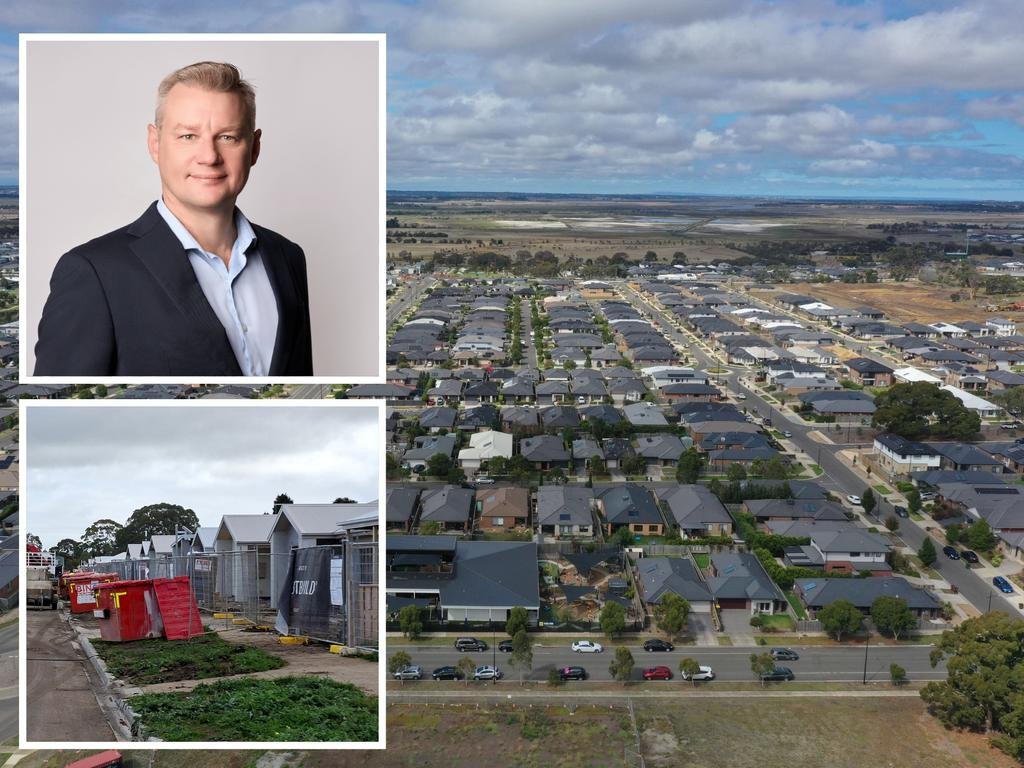

Armstrong Creek is Geelong’s largest new residential corridor. Image: Alan Barber
Concerns about red tape adding to the cost and complexity of housing are growing as Geelong builders say recent tax changes slowing the property market are threatening the pipeline of new housing projects.
Housing Industry Association (HIA) chief executive Keith Ryan hosted a housing roundtable to give political aspirants in Geelong a look at the housing landscape from the perspective of local developers.
But Labor was not present to hear builders explain the increasing pressure they face to deliver the state’s ambitious 2050 housing targets, allowing Mr Ryan to claim the government has stopped listening to builders’ concerns.
RELATED: Experts reveal the best way to buy in a slow market
Award-winning home sells after $1 million price cut
The wild ’70s “Vegas bathroom” is the star of retro reno
Liberal candidate for Geelong Andy Pobjoy, Socialist Alliance candidate and painter and decorator Brenden Grull and One Nation candidate for Western Victoria Chris Burson were at the round table at Rydges Geelong.
The HIA confirmed it had also invited Geelong Labor MP Christine Couzens, but she did not attend.
The state government has set a target for municipalities across the region to build more than 130,000 new homes by 2050.
But the forum heard developers’ growing frustration over the rising costs of state property taxes, navigating the planning system, complying with changing building insurance rules and other registration systems.

Andy Pobjoy, the pre-selected Liberal candidate from Geelong, attended the HIA roundtable. Pictured: Brad Fleet
Developers explained they have to pay thousands to hire an on-site arborist to protect trees – often on the nature reserve – while tenancy laws lead clients to fight in VCAT to legally evict tenants from their own properties when they want to be demolished and rebuilt.
Builders also told the forum that when failures in the domestic building insurance system exposed a lack of enforcement resources, the state government had instead passed new laws that would hurt businesses more.
Mr Ryan said the latest addition to contractors’ growing bureaucratic nightmare was a new registration system for companies employing apprentices.
Geelong Labor MP Christine Couzens was invited to the roundtable but did not attend. Image: Alison Wynd
The forum heard of a growing skills shortage among construction companies and subcontractors, some of whom were struggling to find and retain apprentices, while construction companies laughed off a government official’s suggestion that there would be a rush of tradesmen into the domestic construction sector after major construction projects were completed.
“It’s straight to Brisbane for the Olympics because the Olympics aren’t canceled and they’re so far back,” Ryan said.
The developers agreed that high land prices, rising construction costs and competition from falling prices for existing properties were the biggest problems in the industry.
While builders said a plot of land now accounted for half the cost of building a new home, Mr Ryan said government taxes, duties and other costs accounted for 43 per cent of the cost of a house and land package.
HIA Victorian chief executive Keith Ryan said 43 per cent of a typical house and land package was made up of government charges, taxes and other costs. Image: Phil Yeo/Getty Images
The forum heard Victoria’s windfall profits tax, rising developer contributions and property tax were among the biggest cost hurdles.
And the Albanian government’s recent changes to negative gearing and capital gains tax incentives have worsened conditions for building new homes, they said.
The level of fear for regional developers is unprecedented, Mr Ryan said.
“To date, regional Victoria has been assessed as largely positive, but at least not as worried or stressed as what I experienced today,” Mr Ryan said.
“This is probably partly because Geelong as a development area is becoming more and more like Melbourne.
“But I suspect it is also a signal that one of the few bright spots for housing construction is starting to fade.
“There’s no denying that confidence has been shaken – both consumer confidence and business confidence,” he said.
“This is due in part to the recent federal budget, which was frankly disastrous for some segments and extremely painful for others.
“But we also have a government here in Victoria that no longer listens to you.”
Oliver Hume’s Matt Bell said Geelong’s new property market was performing better than Melbourne.
Oliver Hume’s chief economist Matt Bell said the federal government’s tax changes had led to some weakness in the housing market, but it had already been declining before the Budget was published.
“I can’t forget that we’ve had three rate hikes this year. But removing investors from the market undoubtedly slows price growth.”
Mr Bell said Geelong’s new property market was performing better than Melbourne, with average monthly sales of 120 property blocks in line with the long-term average and an average property price of $397,000.
Established market data shows Geelong is also performing better than Melbourne.
“It’s the top end of the market that’s suffering much more than the bottom end and with Geelong at that median house price of $740,000 and below, compared to a Melbourne average of almost $800,000, it’s in that affordable sector,” Mr Bell said.
But developers in Melbourne began introducing incentives and discounts for new home buyers, something that became more common in Geelong last year.
“They were higher in Geelong than anywhere else,” Mr Bell said.
Cheaper established housing is luring first-time buyers away from new homes. Image: Alan Barber
“We were talking about property discounts of $60,000 to $70,000 (in Geelong) compared to $30,000 and $40,000 around Melbourne.”
Mr Bell said the average property price in Geelong was holding steady at $397,000, just below the average price across Melbourne of just over $400,000.
“There was a reasonably sustained period of Covid and post-Covid where property prices in Geelong were higher than in Melbourne. That wasn’t the natural course of things.”
“It’s still relatively competitive, but probably not competitive enough.”
Mr Bell said government taxes and duties included in property prices had an impact on property sales as buyers were attracted by cheaper prices for already built homes.
“One of the reasons we see in Melbourne – and this is also reflected in Geelong – that the market for new homes and land is not doing as well as other parts of the country is because it is relatively expensive compared to the established market, particularly when it is a market typically driven by first home buyers.”
Mr Bell said there were many examples of recently built homes coming back onto the market for far less than the cost of building the same home new.
Sign up for the weekly real estate update. Click here to get the latest Victorian property market news straight to your inbox.
MORE: How to avoid the biggest new construction pitfalls
Leading Geelong developer unveils new design centre
Large donation from Vic Builder to a children’s charity