
When e-commerce returns reduce profitability, consider logistics or tightening policies. But what if the solution has nothing to do with that? The real answers are in your data.
Understanding the causes of avoidable returns can pay off. Narvar’s CEO told the Wall Street Journal that cutting e-commerce revenue in half could increase profitability by as much as 25%.
The right data shows how your store is creating uncertainty before sales, where operations are failing, and when return policies are costing you big bucks. Most ecommerce platforms offer built-in analytics or reporting dashboards to quickly access these insights. In WooCommerce, you can view refund rates and product performance in WooCommerce Analytics to spot patterns, understand them, and take action.
Almost 1 in 5 online orders are returned. NRF and Happy Returns estimate the e-commerce returns rate at 19.3% of online sales by 2025, compared to 15.8% for all retail channels. There is usually a common cause. Here are some examples of patterns you might encounter:
- If a customer returns due to the wrong size, a missed compatibility detail, or finds that the item did not meet their expectations, it could mean that the product page was not clear enough.
- If an item is damaged, it may indicate a packaging or fulfillment problem.
- Repeated returns from the same customer group may indicate policy abuse.
For merchants handling suspected abuse violations, consider setting up an AutomateWoo workflow. AutomateWoo is designed for non-technical users and requires no coding. The interface makes it easy to set up triggers and actions. You can quickly configure a trigger to send an internal notification or add a tag when a customer’s refund count exceeds a threshold, stopping abuse without relying on manual detection.
To get started, install the AutomateWoo extension and create a new workflow. Set the trigger to “Order refunded” and add a line for the number of refunds per customer. Then choose an action, such as notifying your team by email or adding a customer tag. This setup automatically identifies repeat offenders, allowing you to act quickly without additional manual effort.
The reasons behind returns appear in product data, order history, customer behavior, support conversations, and fulfillment workflows. To see the full picture, export data from different sources and combine it into a spreadsheet, or use simple integrations between your ecommerce platform and support tools.
Basic efforts such as creating a shared spreadsheet with columns for product SKUs, return reasons, and support notes can reveal links you may be missing. If you look at all this information together, you can see whether certain products, customer groups, channels or operational issues are the source.
Start with the sales report in WooCommerce Analytics. Here you can see the refund amounts next to the turnover, so that you can see not only which returns have taken place, but also what they cost in relation to the turnover.
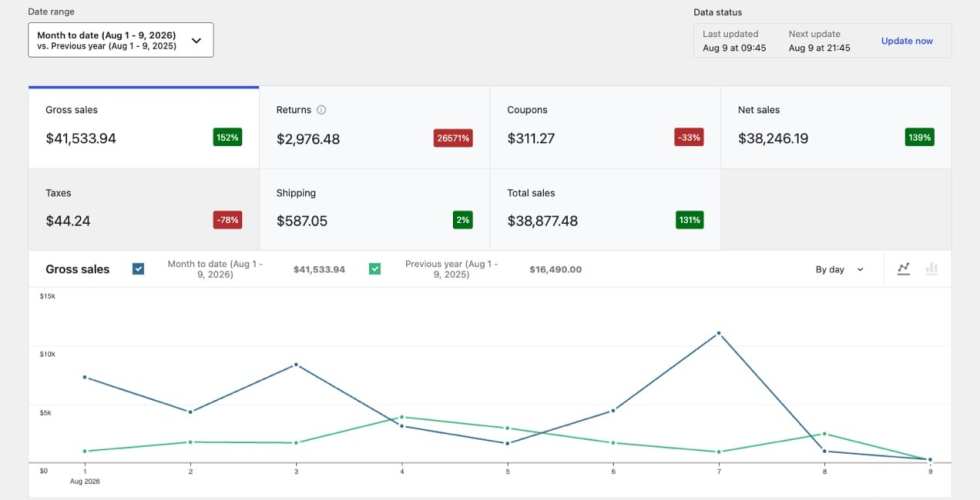
Filter by product and date range and the pattern usually appears quickly. One SKU is responsible for the majority of the refund amount. A peak started the week you changed suppliers. A category returns twice as fast as the rest of your catalog.
To cut through the noise, ask two questions: Which product is responsible for the largest portion of your refund total? Did anything change, such as the supplier, packaging or price, just before the return rate changed?
Data shows where returns happen, but not why. That’s where customers come. A spike in returns after a seasonal promotion could indicate that the marketing promise did not match the actual product. If a countertop appliance has a higher return rate than comparable products, customers may not realize the size, noise level, or included accessories. If customers repeatedly report damaged items, missing accessories, or incorrect products, the problem may be in your fulfillment process.
Support communications contain valuable answers. Ask customers directly when to initiate returns via forms and follow up on messages. For example, you can include questions like:
- “What was the main reason for your return?”
- “Was something missing or different than you expected?”
- “What condition did the product arrive in?”
- “How was your delivery experience?”
To encourage honest responses, keep surveys short, make them optional, or offer a small incentive. Use friendly prompts and keep it simple so customers can share feedback without feeling pressured. These approaches make it easier to discover the reasons behind patterns in your returns data without harming the customer experience.
High return rates often indicate unanswered customer questions on the product page. Before updating, check the product pages with the highest return rates. What questions and concerns can you better address?
If customers repeatedly mention size, please include measurements, size charts or comparison photos. If there is compatibility, please clarify the supported devices and requirements. If expectations don’t match reality, add videos, FAQs, or additional product images that show exactly what they will receive.
When customers return tech products due to compatibility issues, it usually comes down to three things: which models the product works with, what it can’t do, and what power or specifications it needs to function. All of this is listed on the manufacturer’s spec sheet, but often never makes it onto the product page. Look at the reasons why people return your best technical SKU and see if those answers were even available on the page.
Some returns indicate customer friction. Others report abuse. If you can’t tell the difference, you’re making it harder for legitimate customers without addressing the real problem.
Return abuse manifests itself in repetitive behavior such as:
- Claimed shipments never arrived.
- Return packages with missing, counterfeit or broken products.
- Wardrobing, where customers purchase items for temporary use and return them within the refund period.
- Exploiting the loopholes in the return policy.
It’s about responding accurately. Make the buying experience clearer for customers who face friction. Apply stricter rules, review the steps, or consider different refund options when data shows misuse.
Your returns policy does not have to treat every return the same
Your returns policy does not have to be the same for every product and every customer. When returns are unavoidable, the question is how much margin you can maintain while still offering customers a fair experience.
Develop a returns policy that guides customers to their next step based on what they purchased and why they are returning it. Consider the customer’s history and the cost of processing the return.
Build procedures into your policies to protect your margins and the customer experience:
- Where reasonable, please prioritize exchanges over refunds.
- Offer store credit along with a path forward for the customer.
- Send replacements for cheap items instead of paying for return shipping and restocking.
- Use different return rules for defects, buyer’s remorse, and fulfillment errors.
Once the policy is updated, you can clearly communicate changes by notifying customers through email updates, on-site banners, or a special section on your returns page. Use positive, reassuring language to emphasize customer benefits, such as easier returns, more flexible options, or an improved shopping experience.
Framing updates around improvements maintains trust and reduces negative reactions. Being transparent about policy updates ensures customers understand what to expect.
Proactively review your policies, at least quarterly, or after major updates to your business or catalog. This allows you to quickly adapt as your data evolves and customer needs change.
Reducing e-commerce revenue starts with finding the cause; solving the right issues yields the greatest profit. So make sure you open the Returns Report and look for the product with the highest returns before considering changing your returns policy.


Renzo is product marketing manager at Woo. He is a passionate storyteller with over 8 years of experience formulating and executing successful go-to-market strategies for hardware or SaaS products.