

When your most popular product sells out on Black Friday, but your store continues to take orders, that’s the case Real nightmare before Christmas.
Peak season is also the peak time for sleepless nights for ecommerce teams, and inventory sync errors are the cause of much of that back and forth. Not only can inaccurate inventory numbers cost you sales, but you may also find yourself sending an awkward email apologizing for overselling to disappointed customers.
It’s smart to check your inventory before Black Friday and Cyber Monday, but an audit only helps if you can trust the numbers. Before cross-channel sales, you need to establish a single source of truth.
As sales channels and order volumes multiply during BFCM, so does the risk of trusting the wrong number. Preparations for the high season happen just as much in connected systems as in your warehouses.
Inventory issues in the middle of the holiday shopping season usually show up when e-commerce systems don’t agree with each other.
For example, your website doesn’t know what’s being sold on the Amazon marketplace and your physical stores operate on their own numbers. This is the perfect setup for a holiday inventory disaster.
Run a SKU sync test before Black Friday
As part of your mid-year inventory audit, choose three SKUs to test, from purchase to fulfillment. Identify a bestseller, a low inventory item, and a product sold through multiple channels. Then record the available inventory shown in WooCommerce, your POS, your ERP or WMS, and marketplace listings.
Place a verified test order through every major sales channel. Note the time of purchase and what event causes inventory to decrease. Was it the order placement, payment, fulfillment or some other status change? View each affiliate system and record how long it takes for the new quantity to appear.
Also perform the test in reverse. Cancel or refund an order and confirm stock is restored everywhere. If you accept backorders, bundles, or partial fulfillments, test those workflows as well.
The slowest update is your overselling period. If WooCommerce updates immediately, but a marketplace feed takes several hours, that delay is the point where peak season orders could exceed your available inventory. If an update still relies on a spreadsheet, manual entry, or employee message, document the transfer and assign someone to own it until you find a way to automate it.
Your ERP, WMS or dedicated inventory platform should act as the single source of truth. Any other system would have to automatically read from it or send inventory changing events back to the system.
While your ecommerce website shouldn’t serve as a source of truth for inventory in a growing business, it remains an important connection point. WooCommerce exchanges order, product and inventory data with the ERP, WMS, POS or inventory platform that contains the complete picture.
There are native solutions within WooCommerce that monitor inventory. Enable low stock notifications for bestsellers so your team gets an early warning before stock runs out. But while low inventory notifications warn you that a problem is coming, they can’t fix disconnected systems.
You can use native APIs and existing integrations to connect your WooCommerce store to the rest of your systems. For example, NetSuite is the market leader in enterprise resource planning. An integration between NetSuite and WooCommerce allows synchronization in both directions.
That means NetSuite knows what’s being sold on the website and WooCommerce has access to current inventory numbers that are updated as often as every hour.
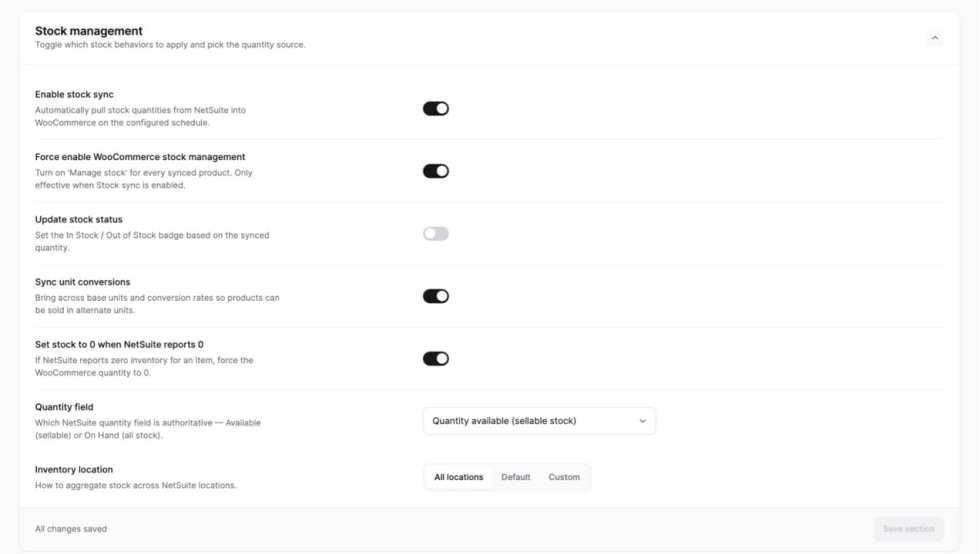
WooCommerce doesn’t need to own your master inventory record to stay up to date. The REST API and webhooks allow an ERP, WMS or inventory platform to read and update product and order data as inventory moves.
Your inventory audit tells you which compounds need attention. If physical sales aren’t reaching your website, connect your POS. If market quantities are lagging, use a multi-channel sync tool. If your ERP contains the master inventory record, connect WooCommerce directly to that system instead of creating another manual transfer.
NetSuite Integration for WooCommerce can send website orders to your ERP and return updated inventory to WooCommerce. Square for WooCommerce keeps online and physical sales and inventory aligned.
For marketplaces, tools like M2E Multichannel Connect or Multichannel for WooCommerce distribute inventory updates and bring marketplace orders back to the connected operation. That includes everything from Amazon, Temu and Walmart to TikTok Shop.
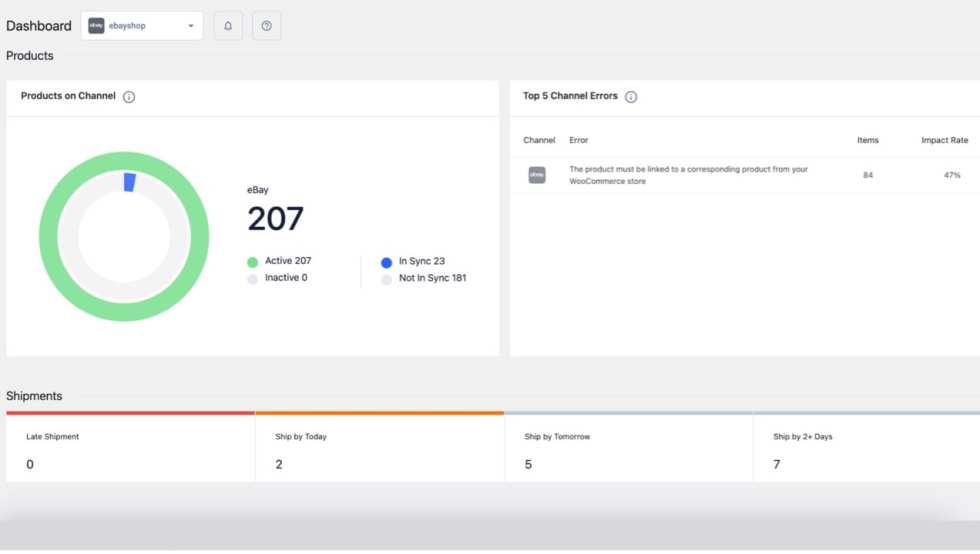
Because it’s part of the open source WordPress ecosystem, a key benefit of WooCommerce is that you can build connections around the tools you have now, as well as the systems you’ll grow into in the future.
Connected inventory doesn’t look the same for every seller. It’s a registry that talks to a website; it is a warehouse that ships as soon as an order comes in; or it’s TikTok orders that find their way into the same system as everything else.
This is what they look like in practice:
Scratch Pet Food automates warehouse processing
The founders of Australian Scratch Pet Food had set up a warehouse integration from day one thanks to a connection to their WooCommerce website. When pet owners make a purchase or renew a subscription, the order and all relevant information travel together.
“An order comes in and we can’t get to it. We have a manufacturer who makes the food according to our recipe. Orders are sent directly to the warehouse and they ship it.”
Mike Halligan, co-founder of Scratch
Smooth warehouse integration was an important part of choosing local partners. Scratch specifically chose a local warehouse that could be integrated with their website and order tracking systems to enable automation.
Every manual transfer carries the potential for delays, missed updates and inventory discrepancies. By choosing partners that could connect directly to WooCommerce, Scratch built a fulfillment process that could grow with them.
Dan-O’s links social selling to its inventory system
You’ll find Dan-O’s Seasoning on the shelves of Walmart and Kroger, but the brand also sells directly to consumers through a WooCommerce-powered website. Their spice blends make great stocking stuffers. So BFCM is an important season.
Social selling helps drive DTC sales for Dan-O’s. The brand even credits TikTok for increasing awareness and popularizing their products. One video with their founder was viewed more than four million times. Going viral in this way can cause sudden spikes in orders.
Dan-O’s sells directly through their WooCommerce store, in addition to Amazon and Walmart marketplaces and 40,000 retail locations. Every online channel they sell through feeds uses Brightpearl, the inventory system that maintains their complete picture, and Brightpearl automatically syncs order information back to WooCommerce.
Instead of matching each channel individually, the connected stack ensures orders flow back to the system responsible for the complete inventory picture.
“WooCommerce allowed us to go from something as simple as we needed in the beginning to a full-featured, customizable site. It gave us the flexibility we wouldn’t get with Shopify or any other platform.”
Ryan Fertig, Senior Marketing Activation Director, Dan-O’s Seasoning
Before order volume increases, make sure your team knows which system holds your actual available inventory. When an item is sold through one channel, do the others update automatically or is someone still moving data by hand?
When was the last time you confirmed that the stock shown online matched the stock actually available in your warehouse?
Then think about what happens if something breaks. If a marketplace feed stops updating or a warehouse sync fails, will your team know immediately, or only after customers start ordering products that you can’t deliver?
Now track one bestseller via every system. Find the gaps before peak season does so your team can enjoy the holidays instead of writing apology emails.


Shubert Koong is a product marketing leader at Automattic, where he manages marketing strategies for WooCommerce.